
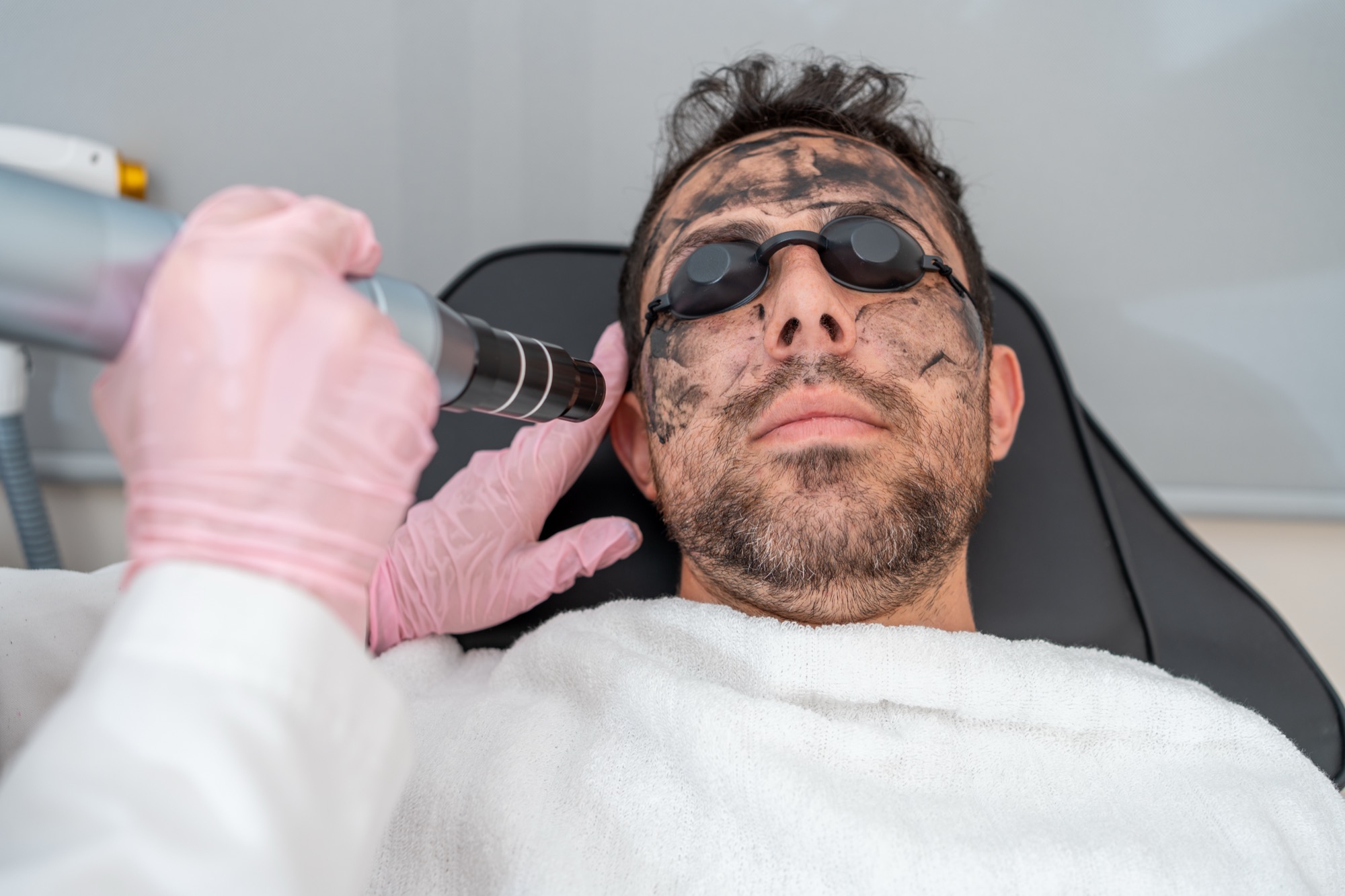
The carbon laser peel — the "Hollywood peel," the "carbon facial" — is one of the most popular glow treatments in aesthetics, and one of the most poorly understood. Its entire effectiveness turns on a piece of laser physics that most places gloss over: the type of laser used. Get it right and you get genuine exfoliation and clearer pores. Get it wrong and you're essentially warming a layer of charcoal on someone's face.
That's an unusually large gap between two things sold under the same name, so it's worth understanding the mechanism properly. Once you do, you can tell a real treatment from a gimmick by asking one question.
The core idea: carbon as a borrowed target
Start with a problem the treatment has to solve. The laser used for a carbon peel emits light at 1064 nm — a wavelength your skin barely absorbs near the surface. Melanin takes it up only modestly; water almost not at all. That's normally a feature: with little to stop it up top, a bare 1064 nm beam travels deep, which is why it's used for deeper treatments.
So how do you use a deep-reaching laser to treat the surface? You give it a target that isn't naturally there. That is the entire job of the carbon.
Activated charcoal is a broadband absorber — it soaks up light across many wavelengths, and it grabs 1064 nm strongly. Painted onto the skin and allowed to dry, it settles into pores and forms an even film exactly where the skin otherwise offers the laser nothing to grip: the outermost layer and the pore openings. In effect, you've handed the laser a surface target on purpose — what a clinician would call an exogenous chromophore, an outside light-absorbing agent placed where the skin has none of its own.
The mechanism: shattering, not heating
Now the target is in place. What happens when the laser fires depends entirely on how fast it delivers its energy — and this is where carbon peels succeed or fail.
The right way — ultra-short pulses. A picosecond (or nanosecond) laser delivers its energy in bursts so brief that the carbon absorbs it faster than the heat can spread into the surrounding skin. Instead of warming up, the carbon fragments — it essentially shatters. It's the same photoacoustic, light-into-sound effect that lets these lasers break up tattoo ink, except here the carbon is sitting on the surface and in the pores, so the tiny shockwave is generated right there at the top of the skin rather than deep inside it. That surface-level shattering does the real work: it mechanically lifts away dead surface cells and debris (the exfoliation) and clears sebum and congestion out of the pore openings (the pore-clearing). That combination is the peel.
The wrong way — long pulses. A long-pulsed laser delivers that same strongly-absorbed energy slowly, over milliseconds — far too slow to shatter anything. The energy becomes bulk heat, deposited under a layer of strong absorber painted across the skin. Instead of clean exfoliation, you get uneven surface heating: not a peel, and with a real margin for irritation rather than renewal. The carbon medium isn't what saves it; the pulse duration is the whole game.
Why the even layer matters, too
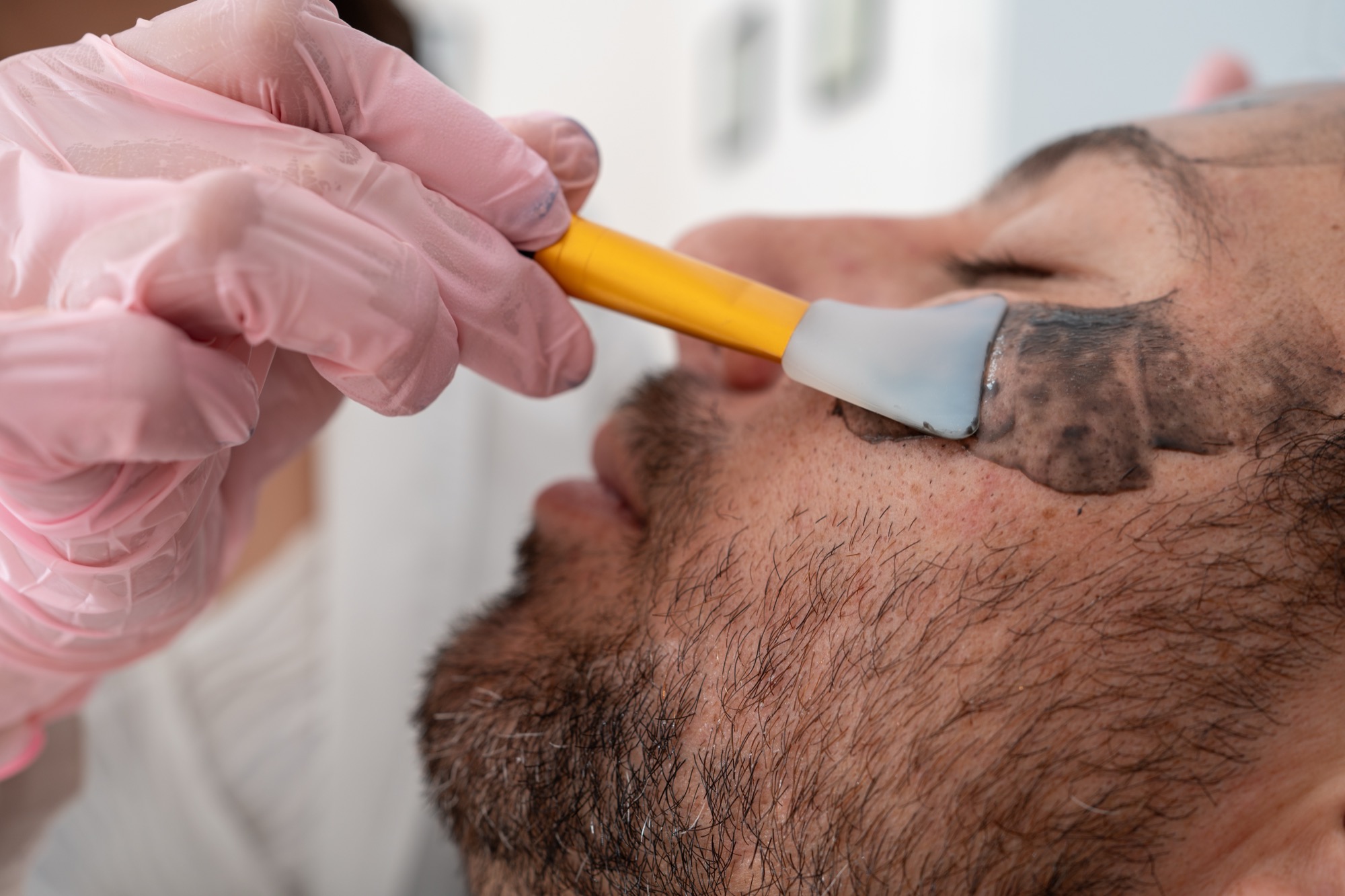
One more detail separates a careful carbon peel from a sloppy one: how the carbon goes on. The medium is applied and allowed to dry so it seats into the pores and forms a thin, even film. That evenness matters because a uniform laser delivery can only produce uniform exfoliation if it's hitting a uniform layer of target. Patchy carbon means patchy results — and patchy absorption is exactly where hot spots come from. The unglamorous prep step is part of what makes the treatment even and predictable.
The one question worth asking
Here's why a skincare explainer is talking about laser physics: the carbon peel is a near-perfect example of why the device and the expertise behind a treatment matter more than the name on the menu. Two clinics can both advertise a "carbon peel" and deliver completely different things — one a genuine photoacoustic exfoliation, the other a warm layer of charcoal — and the difference is simply whether the provider understands the mechanism well enough to use the right laser and settings.
So the question is straightforward: what laser are you actually running this on? A clinic doing it properly will have a clear, physics-based answer. At Oregon Medical & Laser, the carbon peel is run on a picosecond laser precisely because the physics demands it — the ultra-fast pulse is what shatters the carbon instead of heating it — and finished with a polishing step to clear and condition the freshly exfoliated surface.
That's the difference expertise makes: not just performing a treatment, but understanding it well enough to do it right.
References
Yi J, Hong T, Zeng H, et al. Carbon peel laser technique to improve skin quality: back to science! Plast Reconstr Surg Glob Open. 2020;8(9):e3078.
Kim JE, et al. Laser carbon peel: a new armamentarium for inflammatory acne. Reviewed in the dermatologic literature on carbon-assisted Q-switched Nd:YAG laser treatment.